Technical Guide
Understanding and Finding Your Car Tyre Size
As we hit the road, our focus often centers on the thrill of driving, the destination that awaits, or the melodies playing through the speakers. Yet, amidst the excitement, one crucial aspect of our vehicle often goes unnoticed and underappreciated – the car tires. While they are the sole point of contact with the road, car tires are frequently neglected, with car owners remaining blissfully unaware of their technical specifications and the impact they have on their driving experience.
It's a common scenario; car owners may keep a keen eye on the vehicle's appearance, engine performance, and maintenance schedules, but rarely spare a thought for the intricate details of their wheels and tires. Unbeknownst to many, the correct tire size, load capacity, and speed rating are pivotal factors that influence a vehicle's handling, safety, and overall driving efficiency.
In this blog, we'll delve into the reasons why car tires often fall into the shadows of automotive care, explore the consequences of neglecting these crucial components, and empower car owners with the knowledge they need to understand and appreciate the technical specifications of their wheels and tires. We aim to steer car enthusiasts toward making informed decisions that prioritize not only their car's aesthetics and performance but also the safety and longevity of their cherished journeys.
How to read car tyre size?
Identifying the tire size of your vehicle is generally a straightforward task once you know where to look. The tire size information is prominently displayed on the sidewall of each tire. You can find a combination of numbers and letters, such as “P155/80R13 75T” or “215/55Z R17,” providing vital details about the tire's width, aspect ratio, and wheel diameter. While it might appear complex at first glance, understanding these markings becomes intuitive with a little guidance.
The Eurometric System
The Eurometric system is a widely used standard for specifying tire sizes across the globe. A typical tire size is represented as numbers and letters, like “215/55 R17 91T.” Some tires in this system, known as “full-profile” tires, may omit the profile number, like “215 R17,” which is equivalent to “215/55 R17” in the standard format. Additionally, if a tire has a “C” at the end, it is intended for commercial vehicles (e.g. “215/55 R17 C”).
American P-metric System
Introduced by American manufacturers in 1977, it appears as “P155/80 R13 75T.” Tires starting with “P” are designed for passenger cars, minivans, SUVs, and small pickups. The “LT” designation indicates light trucks. A European “C” tire corresponds closely to an “LT” sized tire in the American P-metric system.
Practical Example
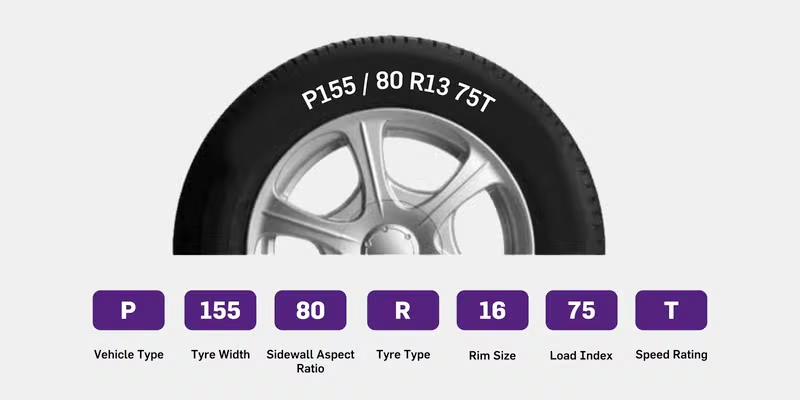
Understanding Tyre Size: P155/80 R13 75T
Know your prefixes “P, T, LT, ST”
The numbering sequence of passenger vehicles starts with the prefix ‘P’, indicating use for passenger vehicles. Other prefixes include T (Temporary Spare), LT (Light Truck), and ST (Special Trailer). Each prefix identifies the vehicle type for which the tyre has been manufactured.
Find out tyre width “P155”
Width is an important parameter if you are thinking about upsizing your car tyres. The first number appearing after the prefix ‘P’ is 155, referring to the width of the tyre in millimetres, measured from one sidewall to another.
Tyre sidewall aspect ratio “/80”
After width there is a forward slash and a number denoting the sidewall aspect ratio percentage. An aspect ratio of 80 means the sidewall height is 80% of the tyre's width.
Tyre type and wheel diameter “R13”
“R” stands for Radial construction, where ply cords run radially from the center outward. “13” specifies the wheel rim diameter in inches that the tyre is engineered to fit.
Load Index “75”
The load index number indicates the maximum weight capacity of the tyre. A load index of 75 corresponds to a load capacity of 387 kilograms per tyre.
Speed rating of tyre “T”
The letter “T” specifies the maximum speed the tyre can safely sustain. “T” corresponds to a maximum speed rating of 190 km/h.
Tyre Profiles, Aspect Ratio & Dimensions
Tyre Profiles Expressed as a Percentage
Tyre profiles, representing the sidewall height, are expressed as a percentage to establish the relationship between the height and width of the tyre. Over the years, tyre profiles have evolved, with each decade witnessing changes to enhance road holding. Using the percentage system allows for easy comparison of different tyre types and divides the entire range into convenient size groups, making it practical for displaying information.
Aspect Ratio and Tyre Performance
The aspect ratio of a tyre determines the sidewall's height, with higher ratios resulting in taller sidewalls. Vehicles like buses and trucks have tyres with high aspect ratios (up to 95) for a more comfortable ride and improved cushioning over bumps. On the other hand, high-performance and racing cars prefer low aspect ratio tyres, which have shorter and stiffer sidewalls. These tyres resist fast cornering forces better, leading to improved handling and reduced roll during cornering.
Rim Size Given in Inches
While tyre width is expressed in millimeters, the rim size of the wheel is traditionally given in inches. This consistent use of inches for rim sizes fits with the established system and avoids inconsistencies that could arise from mixing metric and imperial units. By maintaining this two-system approach, tyre specifications remain orderly and easy to understand for drivers.
Choosing the right tyre size
Choosing the right tire size for your car is crucial, but it can be influenced by various factors, especially if you make modifications to your vehicle. One critical factor is the load ratio, which determines the maximum weight the tire can handle. If you modify the car's weight, either by reducing it for increased speed or adding more mass with a larger engine, you'll need to reevaluate the load ratio and select appropriate tires accordingly.
Another aspect to consider is the tire width. Changing the tire width can significantly impact the car's appearance and stability on the road, but it should be done with caution. Going too narrow or too wide might affect the vehicle's dynamics or result in the tire rubbing against the wheel arch, posing safety risks.
Additionally, the tire diameter is essential to keep in mind. While some people change the wheel diameter for cosmetic reasons, doing so can cause issues with the speedometer and odometer readings since the tire's circumference changes. To maintain accuracy, it's essential to choose the right tire size that aligns with your car's specifications.
Speedometer & Circumference Impact Example
For example, if your car comes with factory-installed tires that are 532 mm in diameter, each tire has a circumference of 1,672 mm. If you switch to non-standard tires with a diameter of 578 mm, each new tire will have a circumference of 1,816 mm – covering 144 mm more with every revolution.
Need help selecting the right tyres?
Explore our full wholesale catalogue or contact Tyre World Namibia specialists for expert advice on tyre dimensions, load ratings, and fleet requirements.